


Falling Rates and Growing Confidence in the US Economy Drive a Bond Revival
- Yiwang Lim
- Oct 12, 2024
- 2 min read

Updated: Oct 14, 2024
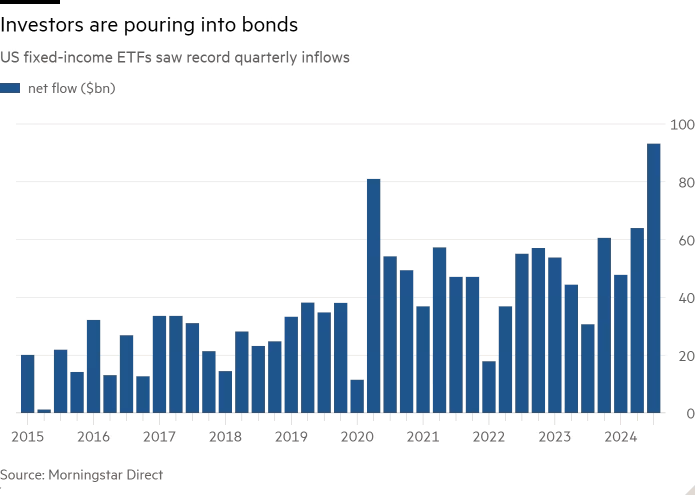
The fixed-income market is seeing renewed interest as falling rates and growing confidence in the US economy spark record inflows into bond funds, particularly exchange-traded funds (ETFs). Investors are re-evaluating bonds, not just as a hedge but as an attractive income-generating option. According to Morningstar data, US bond funds saw an inflow of $123 billion in the third quarter of 2024, with $93 billion going to ETFs. This has benefitted major players like BlackRock, Pimco, and JPMorgan Chase, which have seen assets under management swell significantly.
Key drivers of this resurgence include declining inflation, with US inflation falling to 2.4% in September 2024, and the Federal Reserve’s pivot away from aggressive rate hikes. With market participants anticipating further rate cuts in 2024, the appeal of locking in current yields—like the US 10-year Treasury yield at around 3.9%—while benefiting from potential price gains is proving too tempting to resist.
Moreover, active managers like Pimco have leveraged these conditions to provide impressive results for investors. Pimco’s assets under management hit $2 trillion, highlighting the growing appetite for both passive and actively managed bond strategies. These developments underscore a broader market trend where investors are rebalancing their portfolios in favour of safer, income-generating assets after a volatile couple of years.
MY ANALYSIS
In my view, the current market environment offers an ideal opportunity for investors to increase their exposure to bonds. The significant inflows into bond ETFs reflect a shift in sentiment, with investors now looking for stability and income in the face of economic uncertainty. As the Federal Reserve appears to have reached the end of its rate-hiking cycle, bond yields will likely trend lower, driving capital gains for those holding longer-duration bonds.
However, the key here is not just in passive investing but in actively managing exposure. Investors should focus on extending duration and being selective with credit, balancing government bonds with high-quality corporate bonds. I see opportunities particularly in high-yield credit and securitised debt, where yields remain compelling but require careful selection due to rising leverage in some sectors.
This bond revival could persist well into 2025 as central banks continue to ease policy. For those still holding excess cash, it’s time to consider redeploying into fixed-income instruments to take advantage of both yield and potential price appreciation. The combination of a more stable economic environment, declining rates, and attractive yields presents a compelling case for bonds as a core portfolio component moving forward.


Comments