


UK Borrowing Costs Surge Amid Gilt Market Sell-Off Following Chancellor Reeves' Budget
- Yiwang Lim
- Nov 1, 2024
- 2 min read

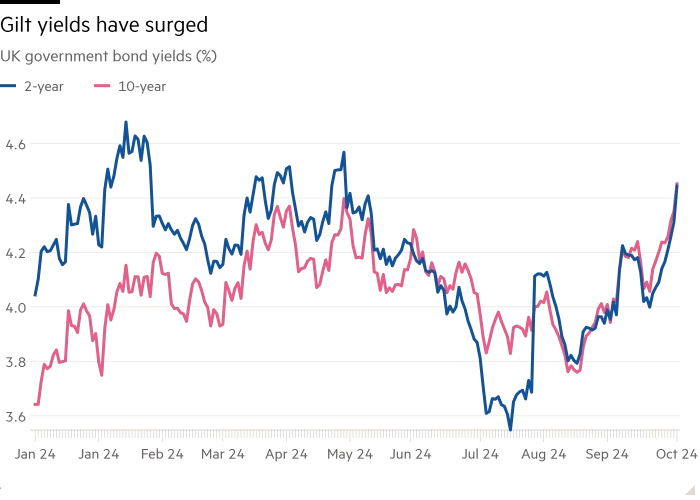
The UK government bond market has experienced significant turbulence following Chancellor Rachel Reeves' inaugural Budget, leading to a sharp rise in borrowing costs. The yield on the 10-year gilt escalated by 9 basis points to 4.44%, briefly surpassing 4.50%—the highest level recorded this year. Concurrently, sterling depreciated by 0.8% against the US dollar, reaching $1.286, its lowest in over two months.
This market reaction stems from investor apprehension regarding the Labour government's announcement of an additional £28 billion in annual borrowing, as outlined in the Budget. The Office for Budget Responsibility (OBR) characterised this as "one of the largest fiscal loosenings of any fiscal event in recent decades."
The Debt Management Office (DMO) has revised its debt issuance forecast for the current fiscal year to £300 billion, up from the previous estimate of £278 billion. This adjustment has intensified concerns about the sustainability of the UK's fiscal trajectory.
The surge in gilt yields brings them closer to the 4.63% peak observed after the September 2022 "mini" Budget under then-Prime Minister Liz Truss, which triggered a crisis in the gilt market and a historic low for the pound.
While some market participants draw parallels to the 2022 fiscal turmoil, others contend that the current situation is distinct. Vivek Paul, UK Chief Investment Strategist at the BlackRock Investment Institute, remarked, "This does not look like a repeat of the market reaction to the 2022 Budget."
The OBR has indicated that the unexpected scale of additional borrowing is likely to result in higher interest rates over the coming years. JPMorgan's Allan Monks noted that Labour's strategy to "tax, borrow and spend on a large scale" would elevate short-term growth and inflation, thereby influencing the trajectory of interest rate cuts.
In the equity markets, the FTSE 100 declined by 0.6%, while the more domestically focused FTSE 250 fell by 1.5%, reflecting investor concerns over the potential economic impact of the Budget.
MY ANALYSIS
The recent sell-off in UK gilts underscores the delicate balance between fiscal stimulus and market confidence. While the government's commitment to bolstering public services and infrastructure is commendable, the substantial increase in borrowing has raised legitimate concerns about fiscal sustainability.
The market's reaction suggests a scepticism towards the government's fiscal projections and a fear of potential future tax hikes or spending cuts to bridge any unforeseen deficits. This uncertainty is reflected in the elevated gilt yields and the depreciation of sterling.
For investors, this environment necessitates a cautious approach. The heightened yields on gilts may present opportunities for those seeking higher returns; however, the associated risks, including potential inflationary pressures and further currency depreciation, must be carefully weighed.
In conclusion, while the government's fiscal ambitions aim to stimulate growth and enhance public services, maintaining market confidence through transparent and credible fiscal policies is imperative to prevent further volatility in the bond and currency markets.


Comments